Huge cliff collapse caught on film
Thursday, 10 September 2015
Huge Cliff collapse in Dorset
Friday, 3 July 2015
Geographical Association Photo Competition
The theme for this year’s competition is ‘Earth Sculpture’.
What's involved
We know that physical geography shapes the land and the sky, but we don't often stop to notice and really appreciate our environment, and how physical geography processes have shaped what we see around us. So here is the perfect opportunity to encourage your students to go out and explore Earth’s land and atmospheric forms.
To take part, students take a photo and write an interesting and informative description of the physical geography they have captured, then submit to the competition website before the close of the competition on Friday 11 September 2015.
The competition website includes advice and suggestions for discovering examples of physical geography plus tips for creating a good entry.
Wednesday, 1 July 2015
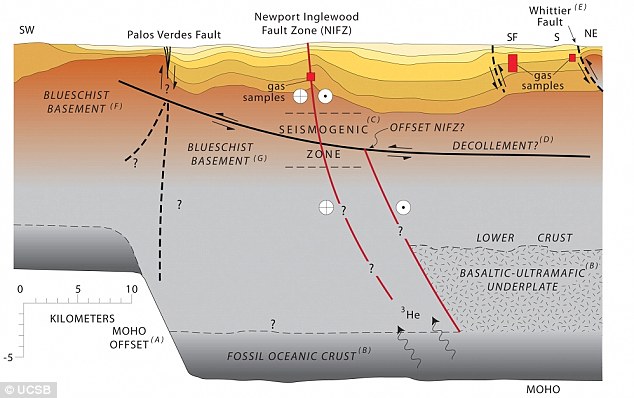
Future Los Angeles Earthquake
A huge fault in the Earth's crust near Los Angeles is leaking helium, researchers have found.
They say the unexpected find sheds new light on the Newport-Inglewood Fault Zone in the Los Angeles Basin.
It reveals the fault is far deeper than previously thought, and a quake would be far more devastating.
It follows a report from the U.S. Geological Survey has warned the risk of 'the big one' hitting California has increased dramatically.
More information below:
Read more: http://www.dailymail.co.uk/sciencetech/article-3143818/Helium-LEAKING-massive-earthquake-fault-LA-raising-fears-big-one-devastating-thought.html#ixzz3ef1nZOZW
Thursday, 25 June 2015
BBC Earth website worth a visit
Extinctions, stars, volcanoes, snowball earth, giant crystals + much more
Hallucigenia: upside down and back to front!
The bizarre creature, named Hallucigenia, emerged during the Cambrian Explosion, a period of rapid evolutionary development starting about half a billion years ago, when most major animal groups first emerge in the fossil record.
Its fossil was first found in the 1970s in the Burgess Shales, but scientists have now discovered they had it both backwards and upside down. What researchers initially thought were legs have turned out to be spines. It’s head had also been mistaken for its tail.
Right side up and right way round, Hallucigenia still looks pretty strange: it had pairs of lengthy spines along its back, seven pairs of legs ending in claws, and three pairs of tentacles along its neck.
The animals were between 10 and 50 millimetres in length and lived on the floor of the Cambrian oceans.
For more information: http://www.telegraph.co.uk/news/11696453/Bizarre-lobster-ancestor-roamed-ocean-500-million-years-ago.html
Sunday, 21 June 2015
BBC Radio 4: In our Time podcasts
In our Time is a 45 minute radio programme hosted by Melvyn Bragg, he is not a scientist and it shows. The discussions are nonetheless very interesting and in the cases below are directly relevant to the A2 Geology course.
The Ediacara and Cambrian programmes follow on directly & consolidate our recent work in class (the time line Geofantasmagram).
Browse here for interesting radio programmes about prehistoric life:
http://www.bbc.co.uk/programmes/p01h9gjr
Or go direct to:
Ediacaran fauna: http://www.bbc.co.uk/programmes/b00lh2s3
The Cambrian explosion: http://www.bbc.co.uk/programmes/p003k9bg
Fossils: http://www.bbc.co.uk/programmes/p00547d3
Chance and design: http://www.bbc.co.uk/programmes/p00548t
Human evolution: http://www.bbc.co.uk/programmes/p003hyfl
For the following topics follow the link at the bottom of the page:
Ageing the Earth
Oceanography
Earth's Origins
Earth's Core
Human Origins
Climate Change
Evolution
Magnetism
Early Geology
Plate Tectonics
Geological formation of Britain
KT Boundary Mass Extinction
Permo-Triassic Boundary Mass Extinction
Vulcanology
Subscribe to:
Posts (Atom)