Thursday, 17 September 2015

Chile quake triggers mass evacuation and tsunami alert

One million people have been evacuated in Chile after a powerful earthquake hit the country's central region. At least eight people died when the 8.3-magnitude quake hit. 
A tsunami alert was issued for the entire Chilean coast but has since been lifted.
The quake that rocked Chile on Wednesday was five times more energetic than the one that devastated Nepal back in April. And yet the early indications are that the death toll will be a fraction (perhaps a thousandth) of what it was in the Himalayan nation.
In large part, this is simply down to preparedness. This was Chile's third massive quake in five years; the region all too frequently experiences magnitude 8 events. As a consequence, the building codes are strict and generally well enforced.
What is more, the people themselves are well versed in how to react during and after an event.
It is not perfect. In 2010, an 8.8-magnitude quake witnessed failings on the part of the monitoring network and the system for alerting people to the imminent tsunami threat.
Since then, the Chilean government has spent millions upgrading the country's seismic network of sensors, and made improvements to telecommunications systems that share critical information and warnings.
For more information click here or for lots of photos (Daily Mail!) here

Wednesday, 16 September 2015

William Smith Bicentenary lectures

Please put these dates in your diary:
I have enough tickets for all geologists (and enough for A level geographers for Iain Stewart)

Leaving Wells at 1730, lectures at Bristol Uni at 1900,  returning at approx 2115: 


  • 07 October 2015 - Professor Iain Stewart - Underground Britain: the story of what's under our feet, and why it matters


  • 14 October 2015 - Simon Winchester - William Smith and his Map that Changed the World: an evening with Simon Winchester
Half term, but I am going to go


  • 28 October 2015 - Professor Richard Fortey - William Smith, fossils and the British landscape

Tuesday, 15 September 2015

Homo naledi, a new species of human, discovered in a cave in South Africa


At least 15 skeletons of the species - named Homo Naledi - were found hidden deep in a cave dubbed the 'Star Chamber' in which is thought to be the earliest form of ritual burial ever discovered.
The early humans stood just five foot tall and weighed 100 pounds. Their hips were similar to our earliest ancestor, the hominid Lucy, but their shoulders were well designed for climbing but legs and feet were human like. Their skulls are like early humans, but their brains are tiny, just the size of an orange.
For more information including a video click here


Journey to the Centre of the Earth


Have a look at this BBC guide to the centre of the earth.

http://www.bbc.com/future/bespoke/story/20150306-journey-to-the-centre-of-earth/index.html

Friday, 3 July 2015

Geographical Association Photo Competition


    The theme for this year’s competition is ‘Earth Sculpture’.

What's involved

We know that physical geography shapes the land and the sky, but we don't often stop to notice and really appreciate our environment, and how physical geography processes have shaped what we see around us. So here is the perfect opportunity to encourage your students to go out and explore Earth’s land and atmospheric forms.
To take part, students take a photo and write an interesting and informative description of the physical geography they have captured, then submit to the competition website before the close of the competition on Friday 11 September 2015.
The competition website includes advice and suggestions for discovering examples of physical geography plus tips for creating a good entry.


Wednesday, 1 July 2015

Future Los Angeles Earthquake


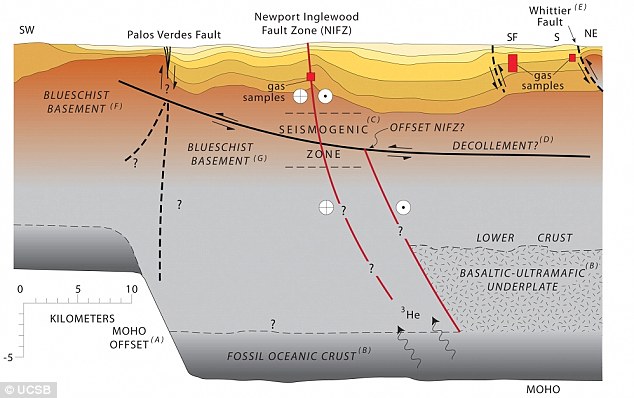
A huge fault in the Earth's crust near Los Angeles is leaking helium, researchers have found.
They say the unexpected find sheds new light on the Newport-Inglewood Fault Zone in the Los Angeles Basin.
It reveals the fault is far deeper than previously thought, and a quake would be far more devastating.
It follows a report from the U.S. Geological Survey has warned the risk of 'the big one' hitting California has increased dramatically. 

More information below: 


Read more: http://www.dailymail.co.uk/sciencetech/article-3143818/Helium-LEAKING-massive-earthquake-fault-LA-raising-fears-big-one-devastating-thought.html#ixzz3ef1nZOZW